
Give each yield a precise meaning
Two offers showing the same rental yield can describe quite different investments. One may divide an advertised annual rent by the asking price, while another deducts operating expenses and includes acquisition costs. Start by writing the calculation in words. Identify the income period, the costs deducted and the amount used as the denominator. Keep that definition beside every percentage you compare. A number without these details is an invitation to ask for supporting information, rather than a reliable basis for ranking properties.
This branch helps you interpret the result before you build a detailed operating budget. Gross rental yield, net operating yield and cash remaining after loan payments answer different questions. None, by itself, measures the eventual profit on sale. Keep possible capital appreciation outside the rental calculation so that an assumed future selling price cannot disguise weak income during ownership.
Compare like with like before ranking properties
Use the same annual period and cost boundary for both candidates. A fully occupied year is not directly comparable with a first year that includes furnishing and a delay before occupation. If one property is furnished and another is not, identify both the purchase commitment and the replacement obligations. Avoid adding an assumed rental premium merely because the furniture looks attractive. Ask what evidence supports the rent for the actual condition and letting arrangement under consideration.
A useful comparison records the property type, size basis, condition, lease period and date of each reference. Asking rents indicate what owners seek; they are not proof of executed terms or amounts received. A building-wide or district-wide observation also needs interpretation before being applied to a particular apartment. Treat differences in evidence quality as part of the decision. More decimal places do not make a weak rent assumption stronger.
Follow one hypothetical calculation all the way through
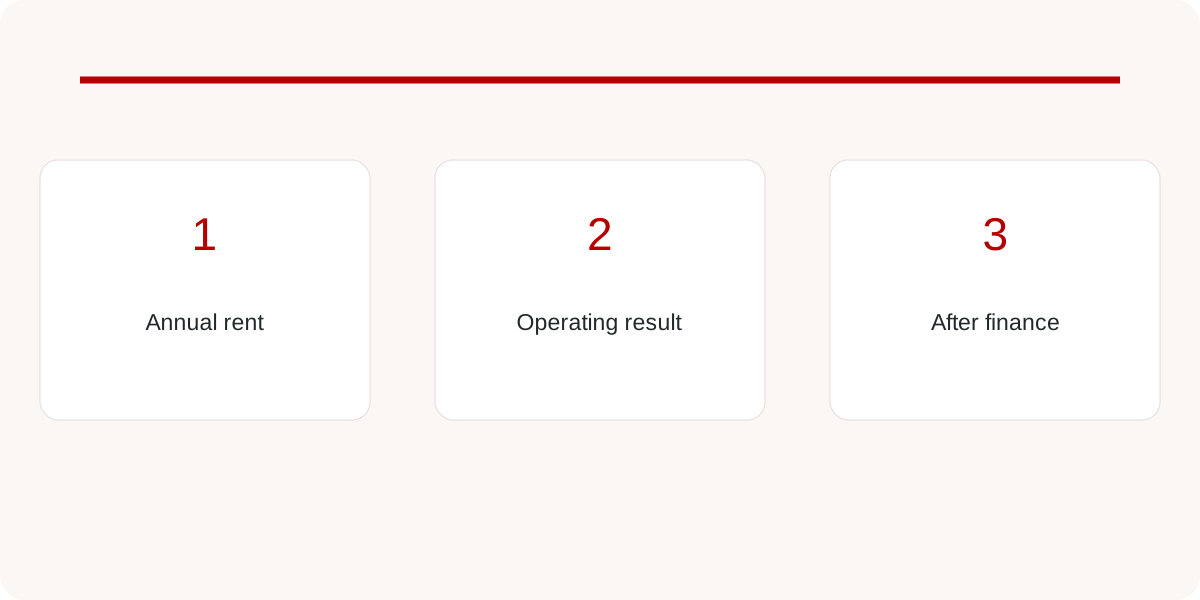
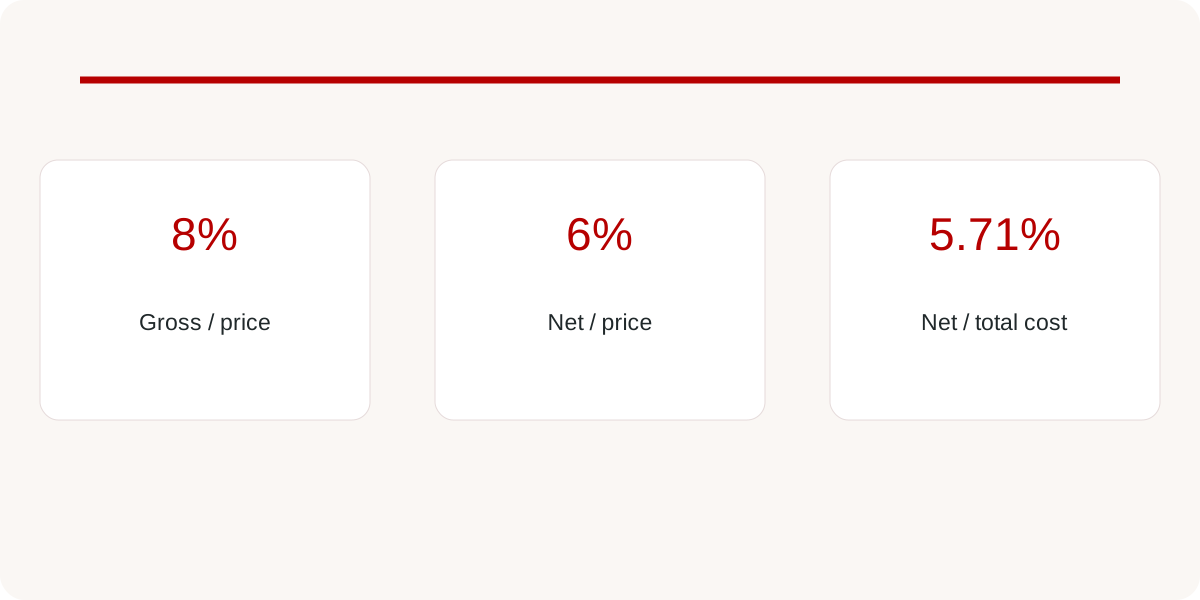
Consider an invented example with a purchase price of AED 1,000,000 and an assumed annual rent of AED 80,000. Dividing the rent by the price gives a gross yield of 8%. Suppose the same model allows AED 5,000 for lost rental income and AED 15,000 for operating expenses. That leaves AED 60,000 before financing and personal taxes. Measured against the price, the net operating yield under this definition is 6%.
Now assume acquisition and initial preparation require another AED 50,000. The same AED 60,000 divided by total acquisition and preparation expenditure of AED 1,050,000 gives approximately 5.71%. No income changed: only the denominator did. These figures are arithmetic illustrations, not Dubai market estimates, a fee schedule or a forecast for any listed property. Replace every assumption with the relevant evidence before using this approach for a real purchase.
| Measure | Calculation | Result |
|---|---|---|
| Gross yield | 80,000 / 1,000,000 | 8% |
| Net / price | 60,000 / 1,000,000 | 6% |
| Net / total cost | 60,000 / 1,050,000 | ≈ 5.71% |
Decide which costs belong in the operating result
Show service charges, management, maintenance and other owner-paid operating items separately, with the reason each applies. Distinguish recurring expenses from initial preparation and occasional replacement expenditure. You can present a normal operating result alongside a more conservative result that allows for replacements, provided both definitions are explicit. Do not deduct the same expenditure twice through a named cost and an unexplained general allowance.
For Dubai, the DLD Service Charge Index offers project, usage and year filters and states that its charge excludes arrears. Match that reference with the relevant property records; a generic index lookup cannot settle the transaction's outstanding balances. Explain who pays each cost under the actual arrangements. A tenant-paid item should not silently become an owner expense, nor should an owner obligation disappear because another listing uses a different convention.
Separate financing from the property's operating performance
After establishing the operating result, add loan payments in a separate calculation. Interest and repayment of principal both use cash, but principal repayment also reduces the debt. Showing them separately helps explain why an owner may have little spendable cash despite a declining loan balance. A return calculated on the owner's initial cash contribution is therefore not interchangeable with an unlevered property yield.
Compare financing choices against the same rental assumptions. Otherwise a more optimistic rent estimate can make a loan appear beneficial without demonstrating that the financing itself improves the outcome. Consider the remaining debt and the capital committed as well as current cash receipts. Borrowing can magnify changes in the owner's financial result; it does not establish better letting performance for the apartment or remove the obligation to meet scheduled payments.
Test the evidence that could change your decision
Choose a few meaningful variations: a lower achievable rent, a gap between occupiers, or a documented increase in an operating expense. First change one assumption to understand its effect, then combine plausible pressures where there is a reason they could occur together. The purpose is to identify what needs verification and what the investment can withstand, not to invent an extreme scenario for every conceivable event.
Finish with a short investment note stating the chosen yield definition, the strongest income evidence, unresolved costs and the conditions under which you would reconsider the offer. If the property is already occupied, read the tenanted-property checklist before assuming the current contract can be replaced with a different rent or possession date. Use the detailed cash-flow model for payment timing, and the market-evidence guide to examine the references behind the assumptions. A credible result should explain the decision, not simply decorate the sales presentation.
- Define the income and cost boundary.
- Record the period and source of each assumption.
- Separate operating income from financing.
- Write the condition that would change your decision.
Sources and reference
- Dubai Land Department — Service Charge Index — Checked 13 October 2026